
Student sustainability staff writer, Reese Lile (’28), contributed to reporting, and sustainability data intern, Tehya Weaver (’26), contributed to data visualization for this article.
Environment and Sustainability is a signature area of excellence, recognized in the University’s strategic framework, Framing our Future. Students who work with faculty in these core areas have unparalleled access to research opportunities ranging from the impacts of illegal gold mining in the Peruvian Amazon to computational modeling and geospatial analysis of the interplay between fire conditions and ecosystem health in the Southeastern United States.
But the boundaries of learning about environment and sustainability extend far beyond research, scholarship, and even teaching in the core disciplines.
Beyond the Core: Opportunities for Teaching and Learning
Opportunities to learn about regional and local solutions to wicked global problems – from institutional climate change mitigation to community-level adaptation – are offered through a diverse array of courses and disciplines right here on the campus of Wake Forest University. Through Campus Engaged Learning (CEL), students across the disciplines are learning about a range of contemporary problems, expanding their understanding of complex systems and the tools needed to generate sustainability-focused solutions for a livable future.
“Our goal is to support faculty across different academic departments and programs, so that students can encounter sustainability issues and solutions no matter what they’re studying,” said Krista Stump, who leads Engaged and Experiential Learning for the Office of Sustainability. “Our vision calls us to transform Wake Forest into a model of sustainability for place-based education. We set a strategic goal in 2020 to ensure that at least 50% of all students are introduced to discipline-specific sustainability content during their time at Wake Forest. CEL is a key strategy for meeting this goal.”
Since 2017, the Office of Sustainability has supported faculty with the integration of sustainability topics into over 130 unique courses across 80% of academic departments and programs at Wake Forest (Figure 1.0).
Examples range from first-year students planting crops at the Campus Garden to enhance their understanding of regenerative agriculture to studio art students drawing original pieces after touring our district heating and cooling system. While these diverse, and sometimes unexpected, courses are integrating campus-based learning experiences, more expected disciplines like engineering are engaging students in semester-long projects like building and testing sensors at the Reynolda wetlands.
Figure 1.0
Introducing First-Year Students to the Forest
Campus Engaged Learning has been particularly popular with faculty teaching First-Year Seminar (FYS) classes (Figure 1.0). Stump attributes this to the more open structure of FYS courses. The flexibility allows faculty to easily incorporate sustainability concepts, including place-based tours and project-based learning into their plans, making these classes interactive for students who are new to Wake Forest.
This connection to first-year students also enhances the Office of Sustainability’s commitment to engagement at all points along the student experience lifecycle. “We engage students at every stage, from their first steps on campus until they walk across the stage at Commencement, and even afterwards as alumni,” says Brian Cohen, who leads Sustainability Engagement for the office. Co-curricular student engagement efforts, which complement campus engaged learning opportunities, prepare students to translate learning outcomes into action across their next four years and beyond.
Emphasizing Place in Place-Based Learning
One popular learning activity – Know Your Place – invites students to explore their surroundings and make sense-based observations that might be unique to the location on campus where they find themselves. Through a series of question prompts about food systems, ecosystems, water, land use, local economies and government in the Piedmont region, they learn about the unique features of this place. Students share and discuss how learning how to understand the unique attributes of this place might help them deepen their understanding of the places where they will live or work in the future.
“Knowing what questions to ask to learn about your place – energy pricing, water availability, what grows when and where in the region – makes you a more capable citizen and a more valuable employee, no matter where you land,” said Dedee DeLongpre Johnston, VP for Institutional Sustainability/CSO at Wake Forest.
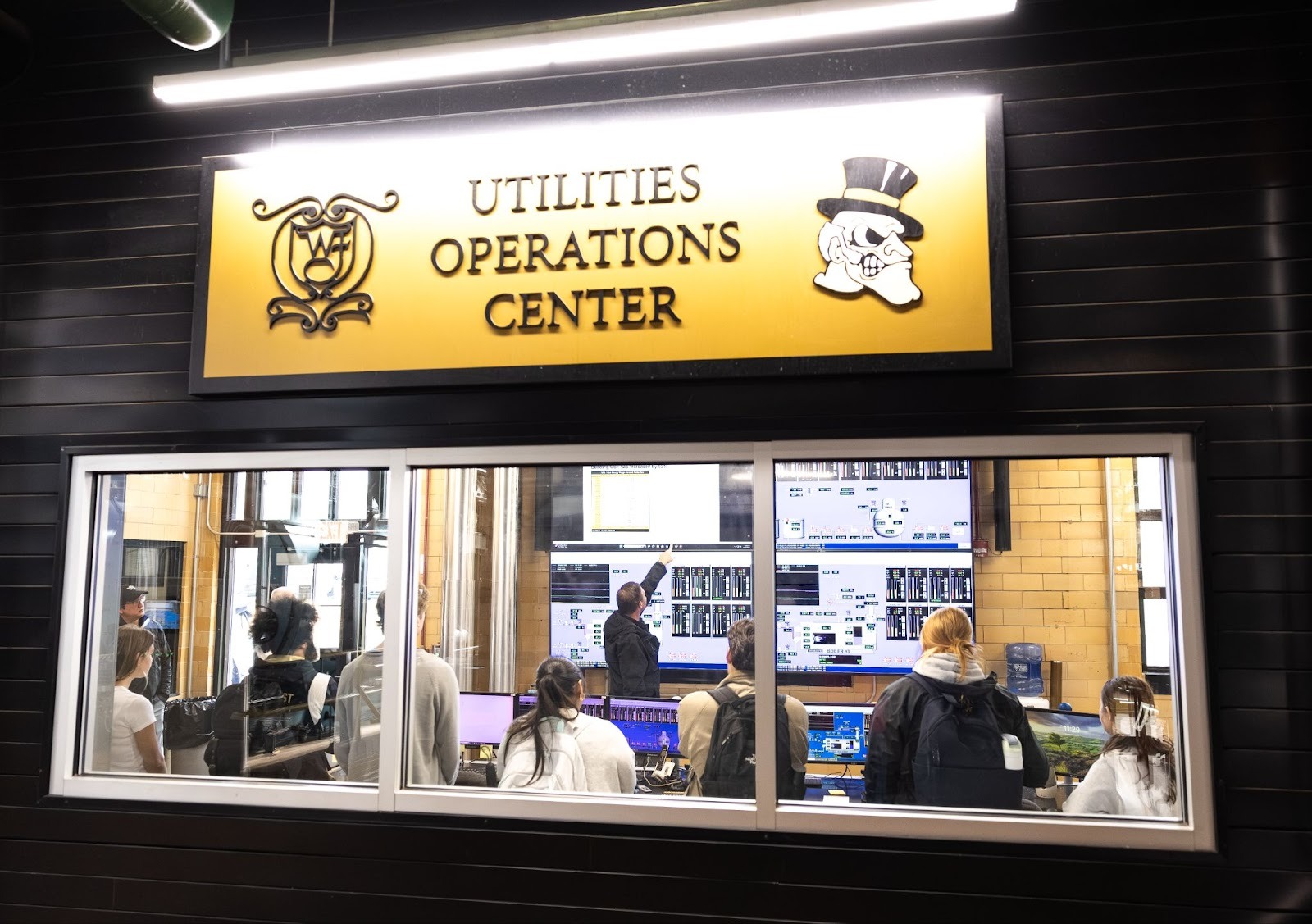
Part of getting to know their place includes exploring Wake Forest’s many sustainability learning spaces. These spaces illustrate some of the unique features of this bioregion and demonstrate what regionally appropriate climate change solutions look like in practice. The Campus Garden, the Tohi Garden, the Winston Hall rain garden, the Lake Katharine wetlands, the South Chiller and Heating Plants, and the residential dining locations are some of the notable spaces where students go to learn about these solutions.
In total, nearly 80% of the curricular engagements the office has facilitated have taken place at sustainability learning spaces outside of the traditional classroom (Figure 1.1). The remaining 20% are in-class exercises, guest lectures, or readings.
Figure 1.1
“Some of the best feedback we’ve received from students is about places that are in plain sight, or that they may not realize are sustainable solution demonstration sites,” Stump said.
In the fall, students in Professor Chelsea Hilding’s dance composition class (DCE 223) choreographed a piece inspired by what they saw and felt at the Winston Hall rain garden. This sustainability learning space functions as a pollinator garden and manages stormwater runoff from the copper gutters on Winston Hall, filtering out biocides and creating a thriving ecosystem. Students were encouraged to design choreography that reflected the cycles of the plants as the seasons changed from summer to fall, and to capture the interactions between the wildlife and native plants.

Through place-based learning, students are able to meet deeper learning outcomes and gain an appreciation and understanding of the world around them.
“One of the main themes that I’m trying to get across in this course is that nothing is precious in the sense that we have to hold onto it forever and ever. We can let things go, and it’s still a part of us and it’ll still be a part of our process,” Prof. Hilding said. “It was such a beautiful, physical metaphor being in that space where everything is let go, but it still becomes part of that space.”
Creating Capacity to Meet Continued Growth
Nearly a decade into the work, the Office of Sustainability continues to see an increase in demand from faculty members who are both new to incorporating sustainability into courses and from returning faculty who have worked collaboratively with the CEL program for years.
In total, nearly 120 individual faculty members have worked with the Office of Sustainability to integrate sustainability topics into their courses through place-based tours, lectures, projects, and experiential learning activities. This aligns with the development of the University’s broader Experiential Learning Initiative (ELI), underscoring the value of, and the university’s commitment to, engaged and experiential learning pedagogies.
Figure 1.2
In spring 2025 alone, Stump coordinated 57 campus engaged learning activities for 23 different faculty members teaching 28 unique courses, reaching over 1,000 students – roughly one-fifth of all undergraduates. The numbers have followed the same trend in fall 2025 and spring 2026.
“It inspires us to see both faculty and students eager for more engaged and place-based learning,” said Stump. “By taking them beyond the classroom and into real-world contexts, we’re helping them build the skills they’ll need to develop sustainability solutions in their lives and future careers.”